Welcome to the College Mathline Blog

This blog accompanies the College Mathline television program produced by Palomar College

Here you can post a question for us or a comment about the show. You can also find information on our "real world" applications of mathematics.

Wednesday, March 4, 2009

Ocean waves


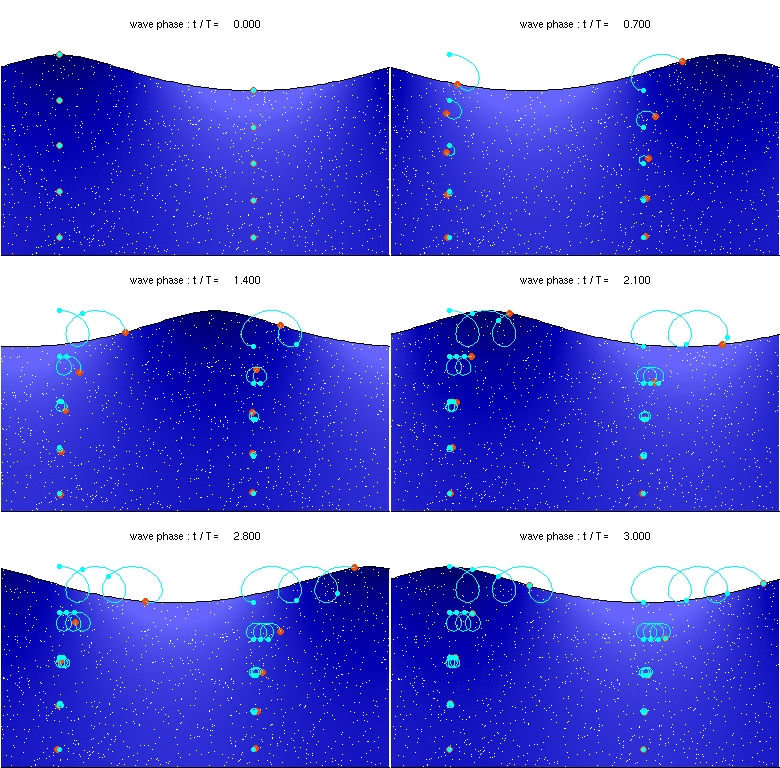
On this week's broadcast we discussed many ways in which mathematics is used in the study of the movement of water in the ocean. It turns out that this is a pretty complicated issue. There are partial differential equations that are used to describe fluid flow, but solutions to these equations have been elusive thus far. Computers are used to estimate approximate solutions with research continually done to improve the results.

We also talked about how water waves resemble the graph of the sine function from trigonometry. A more accurate model is a "trochoid," the path formed by a point on a wheel as the wheel rolls along the ground. Both the sine graph and trochoids are based on circular motion which isn't too much of a surprise since ocean water actually moves in small circles as the shape of a wave moves across the surface.

For further information check out these links.


Thursday, February 26, 2009

Feeding Whales


For our first episode of 2009, we visited SeaWorld in San Diego and met with one of their trainers Mike. We got to help feed the Beluga Whales there and Mike talked with us about the math involved in the animals' diet. The total amount of daily food intake is determined for each animal from several different variables such as gender, weight, age, and time of year. Then proportions of four different kinds of fish must be made for each animal to correctly balance different nutritional elements. These are basically "mixture problems" from an algebra class.

We also talked about methods to estimate the size of crowds, inspired by the Amgen Tour of California bicycle race that finished in Escondido over the weekend. The claim was that 300,000 spectators witnessed the final leg in San Diego county and over 2 million watched the race throughout California. How did they come up with those numbers?

This week's links:


Monday, February 23, 2009

Math Questions Spring 2009

You can leave math questions for us here, as comments to this post, and we will solve them on the broadcast each Wednesday. 

If you aren't able to see the program live, record it for viewing later or you can watch it online when it is archived at www.collegemathline.com.

Mathline returns this week!


The College Mathline returns to its live broadcasts this Wednesday, February 25, at 5:00 PM. 

This semester the program can be viewed on AT&T U-verse channel 99 or as a live webstream available at www.collegemathline.com. The show is also rebroadcast on Saturdays at 6:00 PM.

Have a math question for us? Call us live during the program at (888) 762-1489. Or you can post your question here on the blog before or during the broadcast and we will solve it on the air. You can also email us your question at mathline@palomar.edu. If you aren't able to see the program live for the solution, record it or watch it online once it is archived at www.collegemathline.com.

Wednesday, November 26, 2008

on hiatus

We are ending the season a little early this semester. The television program is now on winter break. We expect to be back on the air in February. In the meantime, we encourage you to leave us feedback here if you have any comments or suggestions about the program. As budgets tighten for everyone, it is helpful to hear from anyone who benefits from the program!

Last week we unfortunately experienced technical difficulties during our last show of the year and the signal got knocked out at the end of the hour. We apologize for that, hopefully that won't happen again!

We wish everyone a great Thanksgiving and holiday season.

Wednesday, November 19, 2008

GPS

If you have used a GPS navigation system in a car, you know how valuable it can be. How does that little electronic device know exactly where you are? It relies on a system of satellites orbiting the earth about 12,600 miles up. At any location, the GPS receiver should be able to see at least 6 of these satellites, each of which transmits information about the locations of all the orbiting satellites along with precise time stamps. The GPS receiver is not capable of communicating back to the satellites, so it listens to these signals and, with lots of mathematics, determines its location.

Specifically, the GPS receiver can determine the synchronized time by comparing messages from different satellites. It can then determine precisely how long each signal took to travel from the satellite to the receiver. The signals travel at the speed of light, so a quick computation tells the device how far away it is from each satellite. On the program this week we showed how having only this information--the distances from several satellites--the GPS receiver can determine exactly where it is on the planet using a process called trilateration. How many satellites are needed to make this happen? The more you have the better, but a minimum of 4 is required (3 if you use information about your elevation on earth).

For more information, check out this very detailed Wikipedia entry.

Wednesday, November 12, 2008

Tricked out Hummers

This week we showed our recent visit to Predator Motor Sports where they retrofit various Hummer vehicles with more powerful engines and upgrades that makes them not only faster and more powerful but also greatly improves their fuel economy. How do they pull this off? As we saw, there is some math behind the scenes. 

As part of the process, they tweak a variety of settings in control modules on a vehicle and then study the interrelated effects on about 150 data tables. A computer helps them with the math between all the variables. One of the most important things they watch is the horsepower of the engine and the vehicle. A dynamometer ("dyno") is used to measure torque and RPM, and a mathematical formula converts this to the horsepower measurement. 

They also have to fit a larger engine with larger components into the original space, so carefully made custom pieces with precise angles and measurements are required that they make themselves. 

You can check out Predator Motor Sports at their website here.