Welcome to the College Mathline Blog

This blog accompanies the College Mathline television program produced by Palomar College. 

Here you can post a question for us or a comment about the show. You can also find information on our "real world" applications of mathematics.

Thursday, April 16, 2009

That's All Folks!


Yesterday was the last live broadcast of The College Mathline. We have been on the air for 9 semesters now and aired a total of 96 episodes.

A big thank you to all the students and viewers who called in or emailed with questions and who worked on our contests! Thanks also to the crew that worked on the show.

All of the episodes are archived at www.collegemathline.com and will remain there for the time being if you want to check any of them out. We'll keep the blog up and running too.

Good luck with your math everyone!

Wednesday, April 15, 2009

hot air balloons

For our last episode, we showed some of the math that helps explain how hot air balloons rise through the air. Most people know that hot air rises, but why? The Ideal Gas Law (pV = nRT) says that if the pressure inside the balloon doesn't change (true) and the volume inside the balloon doesn't change (also true) then an increase in the temperature will cause a decrease in the number of air molecules occupying that space. That means the heated air is less dense than the outside air. A principle stated by Archimedes explains that buoyant force pushes the less dense air upward.

The balloons need to be quite large because this upward force is quite weak, a fraction of an ounce per cubic foot of air. But if you make the balloon large enough (many balloons are 90,000 cubic feet) the buoyant force can be great enough to lift the balloon (800 lbs) and its passengers.

We also showed an equation that can give, approximately, the amount of lift to expect from heating the air a certain number of degrees.

For additional info:

Wikipedia entry on hot air balloons

A nice explanation of the math and physics involved with balloons at How Stuff Works

Thursday, April 9, 2009

new contest!


One last contest for everyone!

Some algebra may be required! If you figure it out, you can be our official winner by calling us and giving us your answer on our final live broadcast, Wednesday April 15. The phone number is (888) 762-1489. Good luck!

unmanned aircraft


This week we showed our visit to Northrop Grumman where we talked with several of their engineers and employees about how math is used in their design of unmanned aircraft, especially the new X-47B jet being developed. One of the key features of these craft are numerous control systems that are used to pilot the craft. Each control is basically a closed loop system that constantly compares the current state of a quantity to a goal value and makes adjustments. This happens many times each second and allows the jets to navigate and land smoothly and safely. One kind of control used is called a PID controller which stands for Proportional-Integral-Derivative. Yes, that's integral and derivative straight out of calculus class. The control uses these three quantities in combination in order to make adjustments quickly but smoothly that avoid overshooting a target value.

We also learned that Northrop Grumman is in need of talented engineers, even in the current economic environment. And, the people working there love what they do! See what math can do for you?

For further reading:

Northrop Grumman's X-47B site

career opportunities at Northrop Grumman

Wikipedia entry on PID controllers

Wednesday, April 1, 2009

Legos & math


For our April 1 episode we talked with Eric, one of Legoland's master model builders. He showed us how mathematics comes into play with his work every day. The dimensions of Lego bricks are based on a 5:6 ratio which he must keep in mind as he plans and builds his models, especially when pieces will be used in atypical ways. He even has special rulers and graph paper to help with the ratio. We also talked about how Lego models, built from rectangular bricks but forming curved shapes, are illustrations of the approximation and limit process from calculus that we use in defining double integrals.

Plus, it was April 1, so April Fools Day pranks and jokes abound!

Wednesday, March 18, 2009

Measuring water purity

This week we showed our interview with one of the chemists, Joel, working at Encina Wastewater Authority in Carlsbad, CA where they treat wastewater so that it can be returned to the ocean. Water samples are tested for the amount of suspended solids as it arrives at the facility and at various stages throughout the treatment process. Joel showed us how he determines the level of solids, measured in milligrams per liter, and what math he does in the process.

The incoming water typically measures between 200 and 400 mg/L, and it leaves the facility at less than 5 mg/L before it heads to the ocean. That's a 99% reduction! 

We also mentioned the March Madness men's college basketball tournament beginning tomorrow. Many organizations offer cash prizes if you correctly predict the winners of all the games (there are 63 games in the tournament). One site is offering $12 million! Are they confident they won't have to award any money? Probably! On the program, we showed the astronomical odds of correctly picking all the right winners. No one has done it yet! Here is an interactive bracket you can fill out for fun on ESPN's website.

Wednesday, March 4, 2009

new contest!


As described above, we have a new contest running. You may need to use a little algebra! If you figure it out, you can be our official winner by calling us and giving us your answer on our next live broadcast (March 18). The phone number is (888) 762-1489. Good luck!

Ocean waves


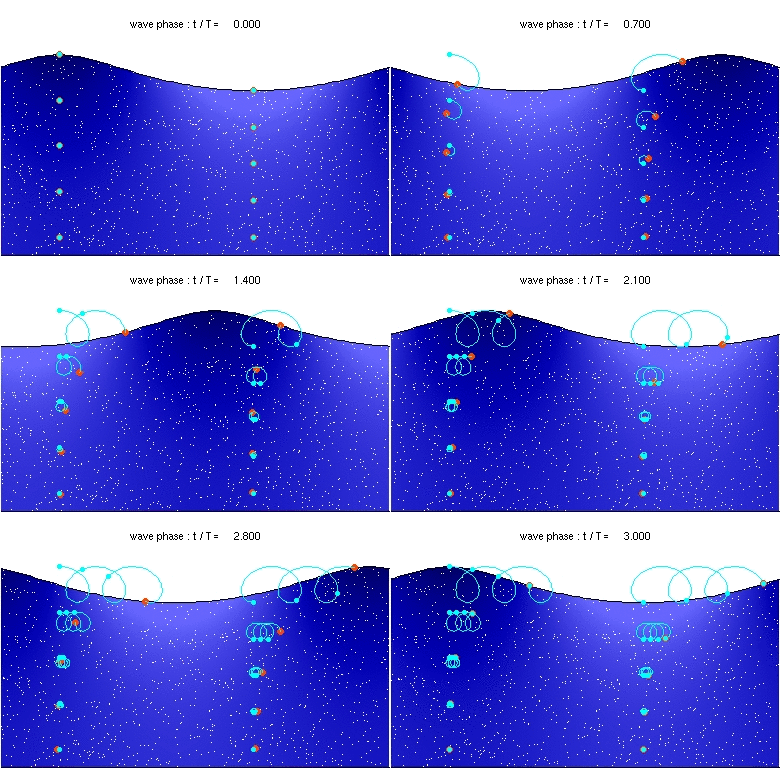
On this week's broadcast we discussed many ways in which mathematics is used in the study of the movement of water in the ocean. It turns out that this is a pretty complicated issue. There are partial differential equations that are used to describe fluid flow, but solutions to these equations have been elusive thus far. Computers are used to estimate approximate solutions with research continually done to improve the results.

We also talked about how water waves resemble the graph of the sine function from trigonometry. A more accurate model is a "trochoid," the path formed by a point on a wheel as the wheel rolls along the ground. Both the sine graph and trochoids are based on circular motion which isn't too much of a surprise since ocean water actually moves in small circles as the shape of a wave moves across the surface.

For further information check out these links.


Thursday, February 26, 2009

Feeding Whales


For our first episode of 2009, we visited SeaWorld in San Diego and met with one of their trainers Mike. We got to help feed the Beluga Whales there and Mike talked with us about the math involved in the animals' diet. The total amount of daily food intake is determined for each animal from several different variables such as gender, weight, age, and time of year. Then proportions of four different kinds of fish must be made for each animal to correctly balance different nutritional elements. These are basically "mixture problems" from an algebra class.

We also talked about methods to estimate the size of crowds, inspired by the Amgen Tour of California bicycle race that finished in Escondido over the weekend. The claim was that 300,000 spectators witnessed the final leg in San Diego county and over 2 million watched the race throughout California. How did they come up with those numbers?

This week's links:


Monday, February 23, 2009

Math Questions Spring 2009

You can leave math questions for us here, as comments to this post, and we will solve them on the broadcast each Wednesday. 

If you aren't able to see the program live, record it for viewing later or you can watch it online when it is archived at www.collegemathline.com.

Mathline returns this week!


The College Mathline returns to its live broadcasts this Wednesday, February 25, at 5:00 PM. 

This semester the program can be viewed on AT&T U-verse channel 99 or as a live webstream available at www.collegemathline.com. The show is also rebroadcast on Saturdays at 6:00 PM.

Have a math question for us? Call us live during the program at (888) 762-1489. Or you can post your question here on the blog before or during the broadcast and we will solve it on the air. You can also email us your question at mathline@palomar.edu. If you aren't able to see the program live for the solution, record it or watch it online once it is archived at www.collegemathline.com.

Wednesday, November 26, 2008

on hiatus

We are ending the season a little early this semester. The television program is now on winter break. We expect to be back on the air in February. In the meantime, we encourage you to leave us feedback here if you have any comments or suggestions about the program. As budgets tighten for everyone, it is helpful to hear from anyone who benefits from the program!

Last week we unfortunately experienced technical difficulties during our last show of the year and the signal got knocked out at the end of the hour. We apologize for that, hopefully that won't happen again!

We wish everyone a great Thanksgiving and holiday season.

Wednesday, November 19, 2008

GPS

If you have used a GPS navigation system in a car, you know how valuable it can be. How does that little electronic device know exactly where you are? It relies on a system of satellites orbiting the earth about 12,600 miles up. At any location, the GPS receiver should be able to see at least 6 of these satellites, each of which transmits information about the locations of all the orbiting satellites along with precise time stamps. The GPS receiver is not capable of communicating back to the satellites, so it listens to these signals and, with lots of mathematics, determines its location.

Specifically, the GPS receiver can determine the synchronized time by comparing messages from different satellites. It can then determine precisely how long each signal took to travel from the satellite to the receiver. The signals travel at the speed of light, so a quick computation tells the device how far away it is from each satellite. On the program this week we showed how having only this information--the distances from several satellites--the GPS receiver can determine exactly where it is on the planet using a process called trilateration. How many satellites are needed to make this happen? The more you have the better, but a minimum of 4 is required (3 if you use information about your elevation on earth).

For more information, check out this very detailed Wikipedia entry.

Wednesday, November 12, 2008

Tricked out Hummers

This week we showed our recent visit to Predator Motor Sports where they retrofit various Hummer vehicles with more powerful engines and upgrades that makes them not only faster and more powerful but also greatly improves their fuel economy. How do they pull this off? As we saw, there is some math behind the scenes. 

As part of the process, they tweak a variety of settings in control modules on a vehicle and then study the interrelated effects on about 150 data tables. A computer helps them with the math between all the variables. One of the most important things they watch is the horsepower of the engine and the vehicle. A dynamometer ("dyno") is used to measure torque and RPM, and a mathematical formula converts this to the horsepower measurement. 

They also have to fit a larger engine with larger components into the original space, so carefully made custom pieces with precise angles and measurements are required that they make themselves. 

You can check out Predator Motor Sports at their website here.

Wednesday, November 5, 2008

Feedback wanted!

As we all know, times are tough economically, and Palomar College is getting hit with budget cuts like everyone else. So, some programs may have to unfortunately be cut. If you would like to see the College Mathline continue, please let us know by leaving a comment here! (Click the "comments" link below.) You can also email us at mathline@palomar.edu.


Thanks!

Water treatment


This week we showed our visit to the Encina Wastewater Authority in Carlsbad, CA where they treat wastewater so that it can be returned to the ocean. Perhaps that's something that you haven't given much thought, but it was quite fascinating to see how they accomplished this task and they have a very impressive facility. And yes, mathematics factors in to many of the processes happening there.

Most of the work treating the water is done by bacteria and other microorganisms. The staff must constantly monitor and adjust the ratio of these organisms to the amount of solid "food" coming in. There is a large aeration tank where the organisms consume the waste followed by a secondary tank where the organisms and matter clump to form an "activated sludge." Some of this sludge is directed back to the aeration tank as needed to keep a 0.5 ratio. In the end, 100% of the sludge is used internally or processed into fertilizer.

After the microorganisms have done their work, the water is ready to be returned to the ocean, after being tested of course.

You can find more information on the Encina Water Authority at their website.

Wednesday, October 29, 2008

Happy Halloween!


Some Pumpkin Pi for you, of course! This week we had a festive episode with a spooky set and costumed crew. We even investigated strange apparitions in the studio. We still did lots of math, as usual, and we had a winner for our contest.

Wednesday, October 22, 2008

Sailplanes and Gliders

Aviation in general involves plenty of mathematics, but we recently talked to Bret at Sky Sailing about how math comes into play in the piloting of sailplanes and gliders. This week we showed our interview with Bret and he explained many different instances of how math and mathematical thinking are necessary skills for flying these amazing crafts. He talked about making sure that the center of gravity of the plane with its passengers is within a certain range; otherwise the plane can be out of balance and can't fly. He also mentioned the "glide ratio" of a plane which is very similar to the algebraic concept of slope. Wind affects a plane's ground speed and navigation, so the speed of the wind must be factored into distance computations and navigation decisions. Brett also mentioned that he is constantly evaluating angles to locations on the ground while in the plane, especially when landing. It's probably no surprise that he also deals with conversions between units as well.

It is well worth visiting Sky Sailing in Warner Springs and going for a ride!


Monday, October 20, 2008

new contest


We have a contest running right now as outlined in the graphic above. You can't change the position of the digits, but you can use as many of those mathematical symbols as you like. You can even put parentheses around digits, like ( 5 4 ), and consider that "54." And if you haven't seen that symbol "^" used before, that is used for exponents. (So 4^3 means 4 cubed.) We know of one way to do it, but there are probably many correct answers. If you find one, you can be our official winner by calling us and giving us the result during the live broadcast this Wednesday, October 22, 5-6 PM. The phone number is 1-888-762-1489. Good luck!

Wednesday, October 15, 2008

Archimedes Screw

The Archimedes Screw was invented over 2,000 years ago and is still in use today! Its purpose is to transfer water to a higher elevation, and it works by turning a large, tilted screw so that the blades of the screw scoop up water, the water sits between the blades as it rides upward, and it is spit out at the top. The photo here was taken at SeaWorld in San Diego where they use two of these devices to push water uphill for their Shipwreck Rapids ride. We spoke with an engineer at SeaWorld about the Archimedes Screws in use there and the mathematics involved in them. 

The screw only works if it is tilted within certain angles, so the concept of slope comes into play, both for the cylindrical screw and the blades themselves. The blades form a mathematical shape called a helix, and if you look at the blades from the side, the contours of the helix match the graphs of sine waves. These sine waves must have a downward slope as they cross the axis of the screw in order to hold water as the screw turns.

During the broadcast we mentioned a research paper (link below) that determined the optimal design for an Archimedes Screw using lots of calculus and 3D graphs. Don't worry, we talked about the highlights on the program which can be viewed once it is archived at www.collegemathline.com. 

This week's links: